
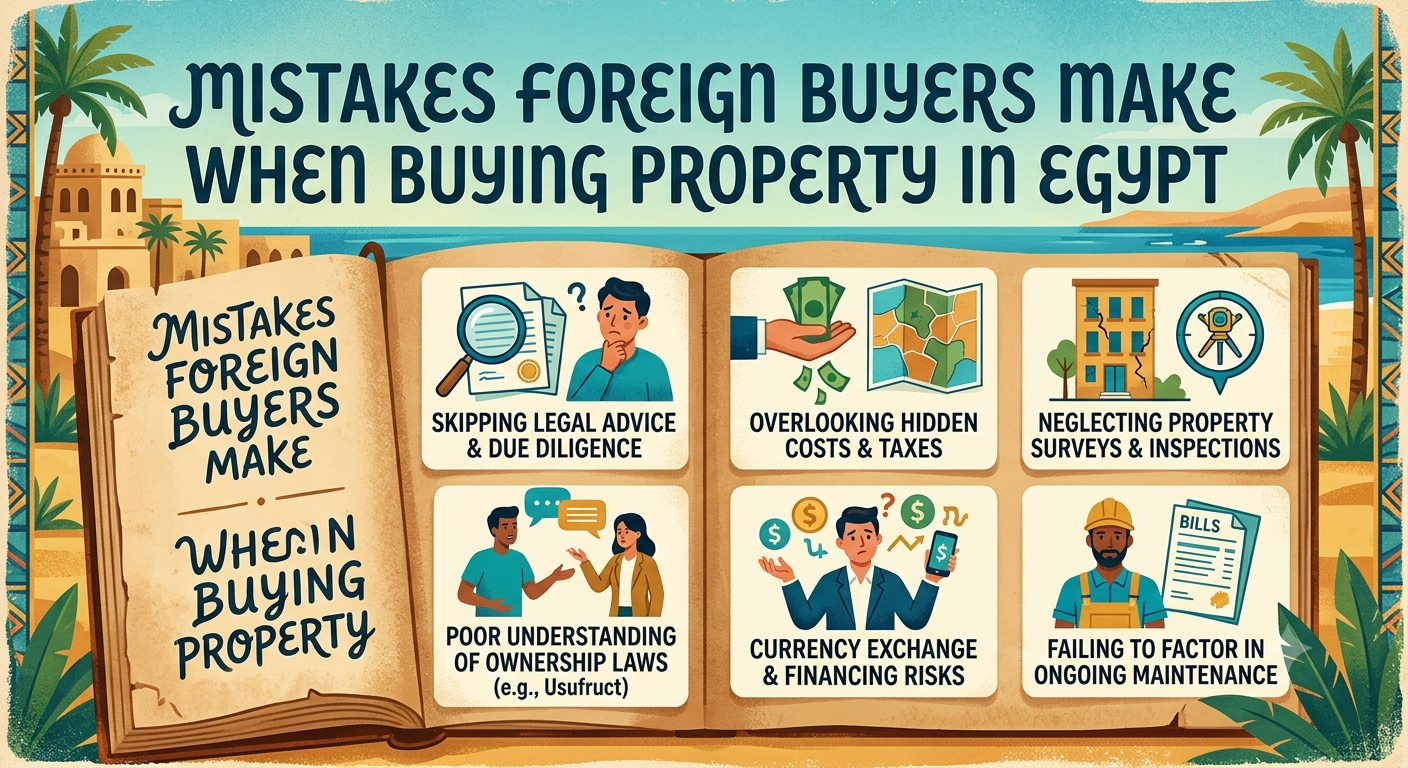
Mistakes Foreign Buyers Make When Buying Property in Egypt
Mistakes Foreign Buyers Make When Buying Property in Egypt can be costly if investors do not understand the local market, legal procedures, property documentation, payment terms, and location differences. Egypt offers attractive opportunities for international property buyers, particularly in destinations such as Hurghada, Sahl Hasheesh, El Gouna, Cairo, and the North Coast. However, finding the right property is only one part of a successful investment.
For foreign investors, buying property in Egypt requires careful research and professional guidance. From choosing the right location and verifying ownership documents to understanding taxes, fees, contracts, and payment plans, every step can affect the safety and profitability of the investment.
Understanding the mistakes foreign buyers make when buying property in Egypt can help investors avoid unnecessary risks and make more confident decisions. Whether you are looking for a holiday home, a rental property, or a long-term investment, knowing what to check before purchasing can save you time, money, and potential legal complications.
Understanding the Egyptian Property Market
Before discussing the mistakes foreign buyers make when buying property in Egypt, it is important to understand how the Egyptian real estate market works. The market includes a wide range of residential and commercial properties, from affordable apartments to luxury villas and beachfront developments.
Egypt has experienced significant real estate development in recent years, with increasing investment in residential communities, tourism destinations, infrastructure, and new cities. This has created opportunities for both local and international investors.
Coastal destinations are particularly attractive to foreign buyers. Areas such as Hurghada, Sahl Hasheesh, El Gouna, and the North Coast offer properties suitable for holiday homes, short-term rentals, and long-term investment. Meanwhile, Cairo and the New Administrative Capital attract buyers interested in residential and commercial opportunities.
However, property prices, rental demand, resale potential, and development quality can vary significantly between locations. A property that looks attractive on paper may not necessarily be the best investment.
This is why foreign buyers should research the area, developer, property type, payment plan, and expected rental demand before making a decision.
1. Failing to Research Legal Requirements
One of the most important mistakes foreign buyers make when buying property in Egypt is failing to understand the legal requirements involved in property ownership.
Foreign nationals can purchase property in Egypt, but ownership regulations can vary depending on the location and type of property. Certain areas may have specific restrictions or additional requirements, making it essential to verify the applicable rules before signing a contract.
Buyers should not rely solely on information provided by a salesperson or property advertisement. Instead, they should obtain independent legal advice and make sure that the property can legally be purchased by a foreign national.
It is also important to understand the documentation required for the transaction. Depending on the property and purchase structure, buyers may need identification documents, contracts, payment records, and other official paperwork.
Working with a qualified local lawyer who has experience in Egyptian real estate transactions can help foreign investors understand the legal process and identify potential problems before completing the purchase.
2. Choosing the Wrong Location
Another major mistake foreign buyers make when buying property in Egypt is choosing a property based only on its price or appearance.
Location plays a major role in property value, rental demand, resale potential, and lifestyle. A cheaper apartment in a poorly connected area may offer less investment potential than a slightly more expensive property in a well-established location.
For example, foreign buyers interested in holiday rentals may benefit from locations close to beaches, restaurants, hotels, entertainment, and tourist attractions. In Hurghada, areas such as Sahl Hasheesh, El Mamsha, Arabia, and other established districts can attract different types of buyers and tenants.
Investors should consider several factors before choosing a location:
Accessibility and transportation
Distance from airports and beaches
Nearby restaurants and shopping facilities
Tourism and rental demand
Future development plans
Quality of surrounding properties
Resale potential
Availability of services and facilities
The right location depends on the buyer’s objective. A holiday home buyer may prioritize beach access and lifestyle, while an investor may focus more heavily on rental demand and future appreciation.
3. Not Checking the Developer’s Reputation
One of the mistakes foreign buyers make when buying property in Egypt is focusing on the apartment itself while ignoring the developer behind the project.
The developer can have a significant impact on construction quality, delivery dates, maintenance, facilities, resale demand, and the overall reputation of the development.
Before buying, foreign investors should research the developer’s previous projects and track record. Look at completed developments rather than relying only on promotional materials for new projects.
Important questions include:
Has the developer delivered previous projects?
Were projects delivered on time?
What is the construction quality?
Are the promised facilities available?
How is the maintenance after delivery?
What do existing owners say about the project?
Is the developer financially and operationally reliable?
A beautiful brochure does not guarantee a successful investment. Researching the developer can help foreign buyers avoid expensive mistakes.
4. Neglecting Property Due Diligence
Thorough due diligence is one of the most important steps when buying property in Egypt.
Foreign buyers should verify the property’s ownership status, documentation, contractual information, and any potential legal issues before completing the transaction.
Property due diligence may include checking ownership documents, reviewing the sale contract, confirming the seller’s right to sell the property, and identifying any existing claims or obligations related to the unit.
A property inspection is also important, particularly when purchasing a resale property. Buyers should check the condition of the apartment, plumbing, electricity, fixtures, finishes, and other important elements.
For off-plan properties, due diligence should focus on the developer, project approvals, delivery timeline, payment structure, specifications, and contractual obligations.
Ignoring these checks is one of the most common mistakes foreign buyers make when buying property in Egypt, because problems discovered after signing the contract can be much more difficult and expensive to resolve.
5. Focusing Only on the Purchase Price
A low purchase price can be attractive, but it should never be the only factor considered.
Foreign buyers need to calculate the total cost of ownership rather than looking only at the advertised property price. Additional expenses may include registration-related costs, legal fees, maintenance charges, utilities, furnishing, management, and potential rental management expenses.
For investment properties, buyers should also calculate the expected rental income and compare it with the total investment cost.
For example, an apartment with a lower purchase price may require significant furnishing or renovation expenses, while a more expensive fully finished property may provide better rental potential and lower initial additional costs.
The best property is not necessarily the cheapest property. The goal should be to find the property that provides the right balance between price, location, quality, rental demand, and long-term potential.
6. Not Understanding Payment Plans
Payment plans are one of the major attractions of the Egyptian property market, especially for off-plan developments. However, misunderstanding the payment structure is another common mistake foreign buyers make when buying property in Egypt.
An advertised installment plan may include a down payment followed by installments over several years. Buyers should understand exactly how much they will pay upfront, the value and frequency of future installments, and whether there are additional payments during construction or at handover.
Foreign investors should carefully review:
Down payment percentage
Installment duration
Installment frequency
Handover payment
Maintenance fees
Additional charges
Delivery date
Consequences of late payments
A payment plan should be evaluated based on the buyer’s complete financial situation rather than simply choosing the longest installment period.
7. Ignoring the Property’s Rental Potential
For investors purchasing property for income, rental potential should be considered before buying.
A property may look attractive as a holiday home but have limited rental demand during certain periods. Foreign buyers should research the local rental market and understand who the potential tenants are.
In tourism destinations such as Hurghada and Sahl Hasheesh, rental demand can be influenced by tourism seasons, location, beach access, property facilities, apartment size, and proximity to restaurants and entertainment.
Buyers should also consider whether the property is suitable for short-term or long-term rentals and whether professional property management will be required.
Estimating rental income realistically can help investors determine whether a property matches their investment goals.
8. Buying Without Comparing Properties
Another important mistake foreign buyers make when buying property in Egypt is making a decision too quickly.
Foreign investors may fall in love with the first apartment they see, particularly when visiting Egypt for a short period. However, comparing multiple properties can reveal significant differences in price, size, location, finishing, facilities, payment plans, and investment potential.
Before making a decision, buyers should compare similar properties in the same area and also consider alternative locations.
A simple comparison can include:
| Factor | Property A | Property B | Property C |
|---|---|---|---|
| Location | sahl hasheesh | el gouna | old sheraton |
| Size | 85 sqm | 90 sqm | 60 sqm |
| Price | 4,000,000 Egp | 3,000,000 Egp | 3,500,000 Egp |
| Payment Plan | 20% Dp with 5 years intsallment | 30% Dp with 4 years intsallment | 40% Dp with 4 years intsallment |
| Delivery | 2028 | 2030 | 2027 |
| View | pool view | lagoon view | sea view |
| Facilities | pool and private beach access , kids area , shopping center | pool and private beach access , kids area | pool and private beach access , kids area , shopping center |
| Rental Potential | — | — | — |
Comparing properties allows buyers to make decisions based on facts rather than emotions.
9. Not Visiting the Property or Area
Online listings, videos, photos, and virtual tours are useful, but they cannot always replace an actual property visit.
One of the mistakes foreign buyers make when buying property in Egypt is purchasing remotely without properly checking the surrounding area.
If possible, buyers should visit the development, inspect the apartment, explore the neighborhood, and evaluate accessibility and nearby facilities.
If an in-person visit is not possible, buyers should work with a trusted real estate professional who can provide detailed videos, property documents, location information, and independent guidance.
The surrounding environment is just as important as the apartment itself.
10. Signing a Contract Without Professional Advice
Finally, foreign buyers should avoid signing a property contract without fully understanding its terms.
Contracts can contain important information regarding payment schedules, delivery dates, cancellation policies, maintenance obligations, property specifications, and responsibilities of both parties.
Even if the contract appears straightforward, buyers should consider having it reviewed by an independent lawyer who understands Egyptian property law and transactions involving foreign nationals.
Taking the time to understand the agreement before signing can help prevent misunderstandings and protect the buyer’s interests.
How Foreign Buyers Can Avoid These Mistakes
Avoiding the mistakes foreign buyers make when buying property in Egypt starts with proper research and professional guidance.
Before purchasing, foreign investors should:
Research the Egyptian property market.
Choose the location based on their investment goals.
Research the developer’s track record.
Verify ownership and property documentation.
Conduct proper legal and physical due diligence.
Calculate the total cost of ownership.
Compare payment plans carefully.
Research rental demand and potential income.
Compare several properties before deciding.
Review the contract with an independent legal professional.
Final Thoughts
Buying property in Egypt can provide foreign investors with attractive opportunities, particularly in popular destinations such as Hurghada, Sahl Hasheesh, El Gouna, Cairo, and the North Coast. However, successful property investment requires more than finding an attractive apartment at a good price.
Understanding the mistakes foreign buyers make when buying property in Egypt allows investors to approach the market with greater confidence and reduce unnecessary risks.
Whether you are buying a holiday home, a rental property, or an investment for the future, take your time, compare your options, verify the important details, and seek professional advice before committing to a purchase.
With the right research and a clear investment strategy, foreign buyers can make more informed property decisions and take advantage of the opportunities available in Egypt’s growing real estate market.
Ready to Buy Property in Egypt?
Find Your Ideal Property in Egypt Today — Contact Our Real Estate Experts
Planning to Buy Property in Egypt?



Join The Discussion